The Culinary Life

A professional foodie at large

macaron recipe

What Is The Difference Between Macarons and Macaroons?

by Stephanie Stiavetti on January 16, 2009 · 23 comments

in Baking, Desserts, European, Gluten Free, Grain Free, Recipes

I’d like to clear this up once and for all: a lot of people are confused about the difference between macarons and macaroons. No, they are not the same thing.

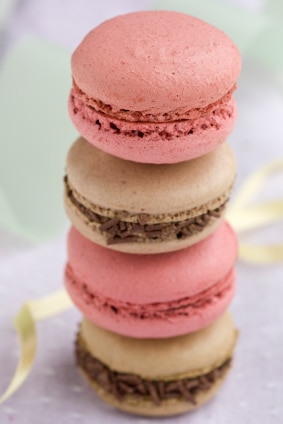
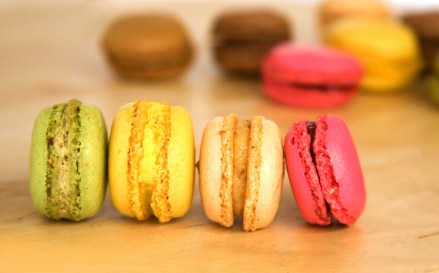
Behold, the macaron:

colorful macarons

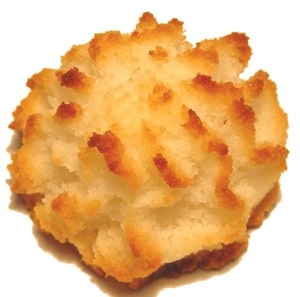
And now, the macaroon:

behold the macaroon

See the difference?

While both recipes are gluten free by default, they’re entirely different cookies. The sandwich-like French macaron is more of a meringue cookie, getting its light, airy texture from egg whites. The Southern coconut macaroon, on the other hand, is a hearty lump of confectionry made of shredded coconut and condensed milk. While you can prepare coconut macaroons in about ten minutes, French macarons are generally more difficult to make – though not so impossible that they elude the home cook.

Below are two recipes, one for each kind of cookie. Enjoy!

Coconut Macaroon Recipe

  • 3 cups shredded coconut
  • 1 cup sweetened condensed milk
  • 1/4 teaspoon salt
  • 2 teaspoons vanilla extract
  • 1/2 teaspoon almond extract
  1. Generously grease two baking sheets, or use silicon baking sheets. Combine all of your ingredients and stir until completely blended.
  2. Drop by teaspoonfuls, 1 inch apart, on prepared baking sheets. Gently press down with the back of your spoon to give them a uniform shape.
  3. Bake at 350° for 15 minutes, or until cookies are golden brown. Allow to cool before removing from baking sheet.
  4. Makes 30-36 cookies.

French Macaron Recipe

(Recipe swiped from Diana’s Desserts – check out her site for other amazing recipes like bourbon truffles and chocolate marshmallows!)

Makes 50 sandwiched macarons.

Ingredients:

For the macarons:

  • 10 ounce confectioners’ sugar
  • 10 ounce finely ground almonds
  • 5 large egg whites
  • Pinch of cream of tartar
  • 1/3 cup granulated or superfine bakers sugar
  • Red and yellow food coloring

For the filling:

  • 9 ounce unsalted butter, softened
  • 5 ounce confectioners’ sugar, sifted
  • 2 ounce finely grated orange zest
  • 1 teaspoon orange blossom water or orange flower water
  • 1/2 cup raspberries
  • 1 teaspoon rose flower water

Instructions:

For the macarons:

  1. Using a fine sieve, sift confectioners’ sugar and finely ground almonds, pushing through with a wooden spoon.
  2. Using an electric mixer, whisk egg whites until foamy. Add cream of tartar and whisk until soft peaks form. Add sugar, 1 tbsp. at a time, and whisk until dissolved. Stir meringue mixture into almond mixture (mixture will be stiff), then halve. Tint one half pink, the other half orange.
  3. Spoon 1 mixture into a piping bag fitted with a 1/2-inch plain round tip. Pipe walnut sized rounds onto parchment paper-lined baking sheets, then repeat with other mixture. Set meringues aside, uncovered, on baking sheets for 1 hour (this will help minimise cracking).
  4. Preheat oven to 300 degrees F/150 degrees C and bake macaroons, 2 baking sheets at a time, swapping sheets halfway through cooking, for 20 minutes or until firm to the touch. Remove from oven and cool on baking sheets. Slide a knife under each macaroon to release from paper, then store in an airtight container until ready to fill.

For filling:

  1. Using an electric mixer, beat butter until pale and fluffy, then gradually beat in confectioners’ sugar until combined. Transfer half the mixture from the bowl to another bowl and add orange zest and orange blossom water. Stir to combine. Add raspberries and rose flower water to remaining mixture in mixing bowl and, using the electric mixer, beat until well combined. Sandwich pink macaroons with raspberry filling and orange macaroons with orange filling.

Tip:
To create a perfectly smooth top on your macaroons, dip a finger into a bowl of water and gently smooth out any peaks.

Further macaron reading, in case you’re intimidated (don’t feel bad, I was too):

Be Sociable, Share!
Get a culinary life!

Keep up to date on posts and recipes:

Ted January 16, 2009 at 4:14 pm

Do you think either recipe could be made vegan? How would you suggest doing it?

Reply

steph January 16, 2009 at 5:10 pm

Hi Ted,

You might try the macaroons with a soy creamer that’s been thickened up a bit – perhaps with arrowroot? I’ve not tried it before, but now you’ve got me curious. This may be my next veganizing adventure.

As far as the macarons go, probably not – eggs whites are pretty essential to meringue. I know several vegans who are on the case, though, and once a vegan meringue has been perfected, I definitely post it here!

Reply

Ronald January 4, 2010 at 11:36 am

Also, “macarons” are what Michelin calls its “stars.”

Reply

steph January 4, 2010 at 4:21 pm

Really? Heh, that’s funny. :)

Reply

Carmelita January 4, 2010 at 12:45 pm

And then there are Italian almond macaroons.

Reply

steph January 4, 2010 at 4:23 pm

I’m still looking for the perfect almond macaroon recipe – care to share your favorite? I’d love to see it!

Reply

Natalie February 5, 2010 at 5:13 pm

But Laduree sell “macaroons” but looks like what you have described as a “macaron”.
.-= Check out Natalie´s last blog post: Overboard =-.

Reply

Cookiepuss March 21, 2010 at 3:17 am

Coconut-based macaroons are not the only version of macaroons we have in the US. The coconut version of macaroon is more a Southeastern US thing. I was making the “French” variety (meringue and ground almond type, with a variety of fillings) back in the 80′s, which we called macaroons. I worked at a NYC bakery in the early 90′s where we made them and called them macaroons. My mother made them in the 40′s, for God’s sake. The only difference I see is that the word macaron is French for the English word macaroon and vice versa. The French meringue version is suddenly very popular, like they never existed in the US before, which is just silly. They’ve been in the US for years. I respectfully have to disagree that there’s any difference between macaron and macaroon, same ingredients, same technique, aside from the obvious spelling of the word.

Both varieties, the almond and the coconut, are different but equally good.

I don’t understand the current glorification of a cookie, however good it is, renamed as macaron and assumed to be better, because it’s suddenly a “new, hot” European import. Please.

Anyway, “macarons” are this year’s cupcake.

Reply

Gloria December 1, 2010 at 6:56 pm

An old midwest favorite cookie of my family is called an Oatmeal Macaron! Its a hearty cookie that has raisins, dates, and nuts in it too. I’m not sure how this one fits in the macaron vs. macaroon debate, but they are delicious!

Reply

Katelyn Williams February 9, 2011 at 6:01 am

If you consult The Concise Larousse Gastronomique (which is considered the finest culinary guide of it’s kind), it describes ‘Macaroons’ as being a small round cake, crunchy on the outside and soft inside, made with ground almonds, sugar and egg whites. The term ‘macaron’ is merely the French translation of this, as is the Italian term ‘maccherone’.

Reply

Joe February 10, 2011 at 4:05 pm

It’s the Americans bastardising the French language again that has caused this confusion.

The pronounce their town Des Moines as “de-moyn”. Wrong.
Its “day muwan”. Clearly a French name! And there are other examples of this crass plebian pronunciation. Makes me cringe with horror at their lack of ability to see outside their borders.

There’s plenty more examples like this. “Gotten” is another word that is just wrong.

French fries? – try skinny chips.
Ketchup – try tomato sauce.
Aluminum? Incorrect. It’s aluminium.

But wait …. there’s more …. cellphone.

Elle Mc-FEAR-son?
Phonetically, try Elle Mc-FUR-son. That’s how her name is pronounced. Pher is fur. Not fear.

Putting the date arse-around is a pain. Day/Month/Year.
Not Month/Day/Year.

There are many other bastardisations which are too numerous to mention here. Suffice to say: it is a dream of mine to see the day when Amercians don’t all have their heads shoved firmly up their backsides, but can pull them out for perhaps a minute or two and see that there really ARE other countries on this planet …. and that the ENTIRE earth DOES, in fact, rotate around the SUN – the sun does NOT rotate around the good ol’ farkin’ US of A(hole).

Reply

Kitty February 10, 2011 at 5:13 pm

“Americans bastardising the French language” not the case at all. English is a language with regional pronounciations and excepted local interpretations, as is French. What makes what the French have/do better? Don’t for a moment think that the French haven’t “bastardized” English words and expressions. Do you really think Americans are the only people in the world who can’t see beyond their borders?

Ketchup is a variation of an Asian dipping sauce, ketsap manis, nothing to do with France, btw.

Here’s my dream for you: move to France or do some traveling in Europe to see what’s really happening outside your little world.

Reply

Winbie June 16, 2011 at 7:07 pm

@Stephanie: I think you are confused between the 2. Actually, the picture u put under “macarons” is of macaroons and vice versa. Besides, if you really read through the recipe for “macarons”, it mentions “macaroons”! Anyway, thanks for the recipe.

Reply

casualremark July 17, 2011 at 8:29 pm

Let’s just call the almond ones “Little Macs” and be done with it. U. S. A.!!

Reply

Leave a Comment

Previous post:

Next post: